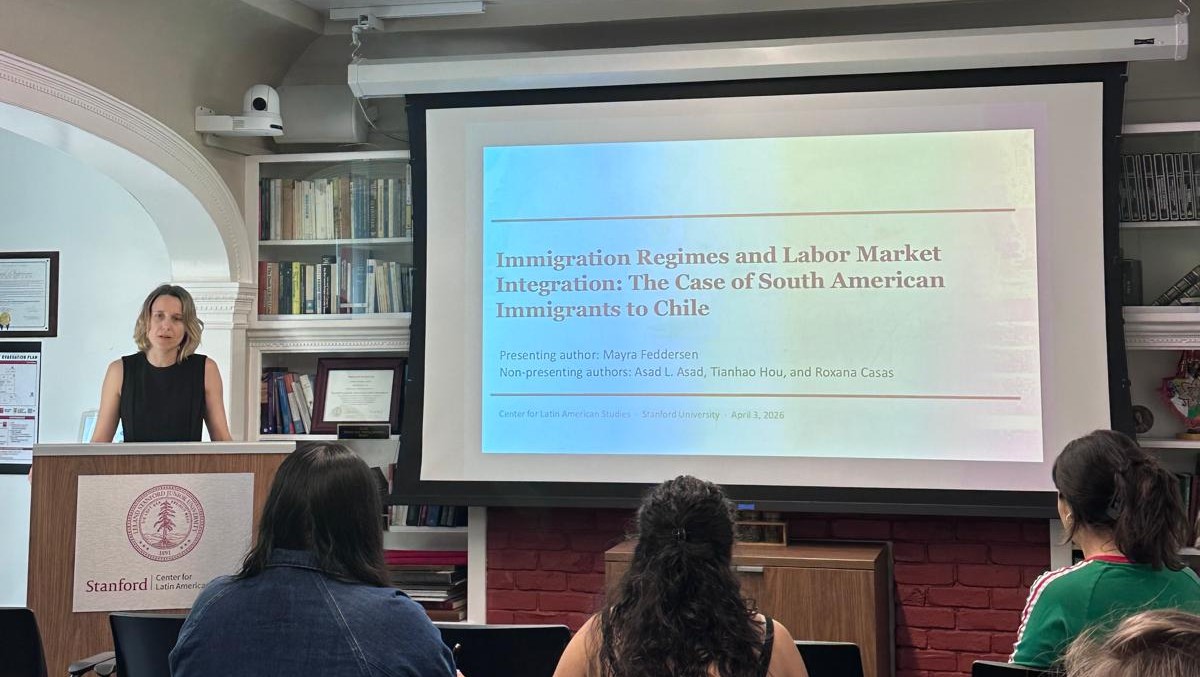
Núcleo Migra researcher Mayra Feddersen presented her latest research at the Center for Latin American Studies (CLAS) at Stanford University, as part of her fellowship as a visiting scholar. The presentation focused on the effects of restrictive immigration regimes on the labor market integration of migrants in Chile.
The study, titled “Immigration Regimes and Labor Market Integration: The Case of South American Immigrants to Chile,” examines how recent changes in Chilean migration policy have reshaped the labor trajectories of migrants from Colombia, Peru, and Venezuela. Using a mixed-methods research design—combining nationally representative survey data (CASEN 2017 and 2022) with in-depth interviews with 69 migrants—the study documents a process of “labor market disintegration” following the reforms implemented between 2021 and 2022.
The findings reveal a significant shift: prior to the reforms, migrants tended to match or even outperform native-born Chileans in key indicators such as employment, income, and access to formal contracts. By 2022, however, these outcomes had deteriorated, with migrants experiencing lower employment rates, reduced incomes, more precarious working conditions, and increased multidimensional poverty.
The research identifies two key mechanisms driving these changes. First, “recategorization,” whereby shifts in eligibility criteria reclassify migrants’ legal status, pushing many into irregularity despite having previously viable pathways to regularization. Second, “hypersegmentation,” which describes how legal precarity confines even highly skilled migrants to unstable, low-quality jobs with no prospects for upward mobility.
One of the study’s central contributions is to show that immigration regimes are not merely background conditions, but fundamental forces shaping labor market outcomes. In this sense, the research argues that “immigration law is also labor law,” highlighting the deep interconnection between migration policy and working conditions.
The study also challenges conventional views of integration as a linear and cumulative process, demonstrating that gains achieved under one regulatory framework can be rapidly reversed under another. In this regard, the Chilean case emerges as an early signal of broader dynamics that may unfold across both the Global North and Global South.
The presentation at CLAS is part of Núcleo Migra’s broader international dissemination efforts, reinforcing its role in advancing academic and policy debates on migration in Latin America.